Architecture
tf_gnns is organized around one central idea: represent graph structure with
plain tensors, express GNN computation as Keras layers and Keras models, and keep
the primitive tensor operations routed through keras.ops. This allows the
same model code to run on the TensorFlow, JAX, and Torch backends supported by
Keras 3.
The architecture below is an idealized view of the core runtime. It omits documentation, examples, tests, and benchmark adapters so the separation between model APIs, GraphNet construction, graph representations, and backend tensor operations is explicit.
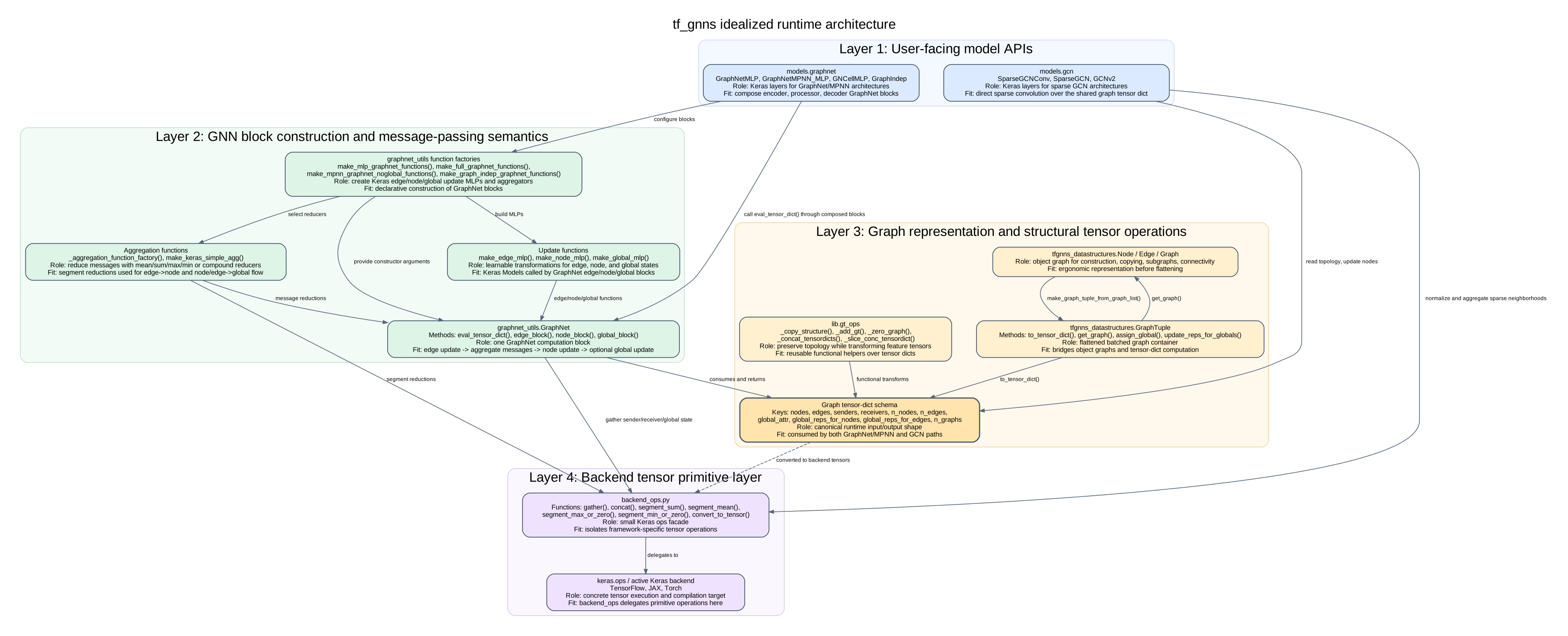
tf_gnns module architecture and data-flow boundaries.
The diagram source is available as architecture.dot. A rendered PDF version is also available for offline review.
Core Design
The library separates graph neural network computation into four layers.
User-facing model APIs provide Keras layers for common GNN families.
GraphNet construction utilities define message-passing semantics and create learnable update functions.
Graph data structures encode graph topology and batch structure in tensors.
Backend operations provide a small compatibility layer over
keras.ops.
The two primary model families are GraphNet-style message-passing networks and sparse GCNs. They use different compute implementations, but they share the same runtime graph representation: a graph tensor dictionary containing node features, edge features, sender indices, receiver indices, graph counts, and optional global features.
Layer 1: User-Facing Model APIs
The high-level APIs live in tf_gnns.models and are regular Keras layers.
They are the entry points most users compose into larger Keras models.
tf_gnns.models.graphnet provides GraphNet/MPNN layers:
GraphNetMLPAn encode-process-decode GraphNet with edge, node, and global states. It is suitable when graph-level attributes are part of the model state or output.
GraphNetMPNN_MLPAn encode-process-decode MPNN that omits global updates. It is useful for common message-passing workloads over node and edge states.
GNCellMLPA single GraphNet processing cell implemented with MLP update functions.
GraphIndepA graph-independent transform that updates node, edge, and optionally global features without message passing.
tf_gnns.models.gcn provides sparse GCN layers:
SparseGCNConvA single sparse graph convolution. It gathers source node states with
senders, aggregates them into destination nodes withreceivers, and applies a trainable linear transform with optional self-loops, normalization, bias, activation, and normalization layers.SparseGCNA stack of
SparseGCNConvlayers with dropout and optional residual connections.GCNv2A higher-level tunedGNN-style GCN stack with repeated hidden convolutions, residual projection, dropout, optional shortcut accumulation, and a dense prediction head.
Both families accept and return graph tensor dictionaries. This is the main contract that lets higher-level Keras models wrap GNN blocks while preserving graph topology.
Layer 2: GraphNet Construction and Message Passing
GraphNet-style models are built from tf_gnns.graphnet_utils.GraphNet. A
GraphNet object represents one message-passing block. It owns three kinds of
functions:
edge_functionComputes updated edge/message states from any combination of edge state, sender node state, receiver node state, and global state.
node_functionComputes updated node states from node state, aggregated incoming edge messages, and optionally global state.
global_functionComputes updated graph-level features from global state and aggregated node and edge states.
The main runtime method is GraphNet.eval_tensor_dict(). It evaluates one
GraphNet block over the tensor-dict graph representation:
edge_block()gathers the sender and receiver node rows referenced by each edge, gathers repeated global state when requested, and calls the Keras edge update model.node_block()aggregates updated edge states byreceiversusing a segment reducer, then calls the Keras node update model.global_block()optionally aggregates node and edge states by graph id and calls the Keras global update model.
The helper factories in graphnet_utils create the Keras models and reducers
used by GraphNet:
make_edge_mlp(),make_node_mlp(), andmake_global_mlp()Construct named-input Keras MLPs for the edge, node, and global update functions.
make_mlp_graphnet_functions()Creates a full dictionary of constructor arguments for
GraphNet, including edge/node/global functions and aggregation functions.make_full_graphnet_functions()Builds a GraphNet block that consumes and updates global state.
make_mpnn_graphnet_noglobal_functions()Builds an MPNN block with edge-to-node message passing but no global state updates.
make_graph_indep_graphnet_functions()Builds a graph-independent block that transforms features without message passing.
Aggregators are created by _aggregation_function_factory(). The simple modes
mean, sum, max, and min map directly to backend segment
reductions. Compound modes such as mean_max and mean_max_min_sum compute
multiple reductions and concatenate their outputs, increasing the information
available to the node or global update function.
Layer 3: Graph Representation
The graph representation layer has an ergonomic object form and a computational tensor form.
Node,Edge, andGraphThese classes represent object graphs. They are convenient for graph construction, copying, connectivity checks, and subgraph extraction. Edges connect source and destination
Nodeinstances, and each edge carries its own edge feature tensor.GraphTupleThis is the flattened batched representation. Instead of storing Python object references, it stores tensors and index arrays. All node features are stacked in
nodes; all edge features are stacked inedges; topology is encoded bysendersandreceivers. Batch boundaries are stored inn_nodesandn_edges. Global feature broadcasting and aggregation useglobal_reps_for_nodesandglobal_reps_for_edges.GraphTuple.to_tensor_dict()Converts a
GraphTupleinto the dictionary format consumed by GraphNet and GCN layers. This dictionary is the canonical runtime interface.
The graph tensor dictionary contains these core keys:
nodesNode feature tensor with shape
[num_nodes, node_feature_size].edgesEdge feature tensor with shape
[num_edges, edge_feature_size].sendersandreceiversInteger index tensors of shape
[num_edges].senders[i]is the source node for edgeiandreceivers[i]is the destination node.n_nodesandn_edgesPer-graph counts for batched graph processing.
global_attrOptional graph-level feature tensor with shape
[num_graphs, global_feature_size].global_reps_for_nodesandglobal_reps_for_edgesInteger index tensors mapping each node or edge row to its graph id. These are used to gather graph-level state to nodes/edges and to aggregate node/edge state back to graph-level outputs.
n_graphsNumber of graphs represented by the flattened batch.
The helpers in tf_gnns.lib.gt_ops operate on this dictionary while preserving
topology. For example, _copy_structure() copies only structural fields,
_add_gt() adds feature tensors from two compatible graphs, and
_concat_tensordicts() concatenates feature channels while keeping the same
connectivity.
Layer 4: Backend Tensor Primitives
Backend independence is provided by tf_gnns.backend_ops. This module is a
small facade over keras.ops. Core library code uses this facade instead of
calling TensorFlow, JAX, or Torch APIs directly.
Important primitive operations include:
convert_to_tensor()converts Python, NumPy, or backend-native inputs into tensors for the active Keras backend.gather()selects rows for sender nodes, receiver nodes, or repeated global state.concat()joins feature tensors, especially for compound aggregations and MLP inputs.segment_sum(),segment_mean(),segment_max_or_zero(), andsegment_min_or_zero()implement sparse graph aggregation by segment id. These operations are the primitive foundation for edge-to-node and node/edge-to-global message passing.
Because these primitives delegate to keras.ops, the same high-level model can
run with KERAS_BACKEND=tensorflow, KERAS_BACKEND=jax, or
KERAS_BACKEND=torch when the corresponding backend is installed.
GraphNet/MPNN Runtime Flow
A typical GraphNetMPNN_MLP call follows this path:
The user passes a graph tensor dictionary to the Keras layer.
The layer applies a graph-independent encoder built from
GraphNetblocks.Each processor step calls
GraphNet.eval_tensor_dict().The edge block gathers source and destination node states and computes edge messages.
The node block aggregates incoming edge messages with backend segment operations and computes updated node states.
Residual connections optionally add the processor output back into the latent graph state.
A graph-independent decoder maps latent node and edge states to output feature sizes.
GraphNetMLP follows the same encode-process-decode pattern, but includes
global state in the encoder, processor, and decoder when global_attr is part
of the input graph.
Sparse GCN Runtime Flow
The sparse GCN path is more direct. It does not instantiate GraphNet blocks.
Instead, SparseGCNConv.call() implements the sparse convolution explicitly:
Read
nodes,senders,receivers, and optionaledge_weightsfrom the graph tensor dictionary.Optionally append self-loops.
Compute symmetric degree normalization weights.
Gather source node states using the edge source indices.
Scale gathered source states by normalized edge weights.
Aggregate scaled messages into destination nodes with
segment_sum.Apply trainable linear transformations, optional root transform, bias, normalization, and activation.
Return a copied graph tensor dictionary with updated
nodesand preserved topology.
SparseGCN and GCNv2 stack this convolutional primitive into deeper Keras
layers, adding dropout, residual paths, and prediction heads as needed.
Why This Is Backend Independent
tf_gnns keeps the backend-dependent part of GNN computation small. Model
composition is handled by Keras layers and Keras models. Graph topology is stored
as ordinary tensors and index arrays. Message passing is expressed through a
small set of primitive tensor operations: gather, concatenate, matrix multiply,
and segment reduction.
Keras 3 supplies backend-specific implementations of those primitives through
keras.ops. tf_gnns.backend_ops centralizes the details needed by graph
computation, including dtype handling and zero semantics for empty segment
reductions. As a result, the higher-level GraphNet and GCN code can remain
backend-agnostic while still using efficient sparse tensor-style computation.