Facts, Rules, and Explanations
Use standalone reasoning when you want to state what follows from selected facts, rather than query only stored graph records. No database is required. A Datalog program contains rules; the evaluator applies them to input facts and returns their closure. It does not silently write conclusions back to a database. The Concepts and Terminology explains unfamiliar terms throughout the reasoning guides.
The vocabulary, before the code
Consider two toy assertions: a drug binds a protein, and the protein is in a pathway. Our example rule calls the drug a candidate for that pathway. This is a synthetic reasoning example, not a claim of medical efficacy.
A fact is concrete:
binds(aspirin, ptgs1).bindsis the predicate (relation name), and its two arguments make it binary.An atom is a relation pattern, such as
binds(x, y).xandyare variables; matching concrete facts binds them to values.A rule’s body contains its premises. Its head is the conclusion. Shared variables require matching values in every premise.
A witness is one recorded explanation of a conclusion: which rule and concrete premises produced it. It is not all possible explanations.
Read the rule below as “if x binds y and y is in pathway z, derive that x is a candidate for z”:
← means “follows from”; ∧ means both conditions hold. These predicates
and variables map directly to the Python rule objects in the example.
Run a rule and inspect one explanation
Standalone runnable example. The base installation is sufficient; no backend, solver or visualization extra is required.
Standalone example. Install with python -m pip install "gestaltdb".
 1from gestaltdb.reasoning import (
 2    Atom, DatalogEngine, Fact, Program, ReasoningLimits, Rule, Variable,
 3)
 4from gestaltdb.viz.api import VizOptions, visualize_proof_explanation
 5
 6x, y, z = Variable("x"), Variable("y"), Variable("z")
 7program = Program([
 8    Rule("candidate", [Atom(x, "binds", y), Atom(y, "inPathway", z)],
 9         Atom(x, "candidateFor", z)),
10])
11facts = [Fact("aspirin", "binds", "ptgs1"), Fact("ptgs1", "inPathway", "pathway-A")]
12result = DatalogEngine().evaluate(
13    program, facts, limits=ReasoningLimits(), collect_proofs=True,
14)
15conclusion = Fact("aspirin", "candidateFor", "pathway-A")
16assert conclusion in result
17explanation = result.explain(conclusion)
18assert not explanation.truncated
19
20figure = visualize_proof_explanation(
21    explanation, options=VizOptions(node_label_property="label", edge_labels="all"),
22)
23svg = figure.as_svg(width=1000, height=360)
24assert "candidateFor" in svg
In the binary API, Fact and Atom use subject, predicate, object order,
so Fact("aspirin", "binds", "ptgs1") expresses
binds(aspirin, ptgs1). Variables are explicit Variable values; the string
"x" alone is a constant, not a variable.
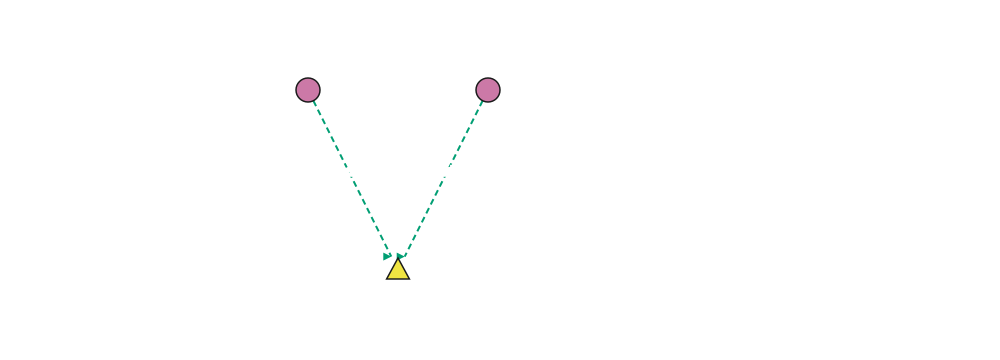
Generated by GestaltDB’s visualize_proof_explanation from this rule and
its evaluated explanation. Circles are input facts, the triangle is a derived
conclusion, and dotted arrows name the deriving rule. Arrows are explanation
dependencies, not physical graph relationships.
Use figure.save_svg(path) for static output or figure.save(path) for an
offline interactive HTML artifact. The figure above is committed static output;
Sphinx users do not need a running database or browser visualization application
to read it. See Explore graphs and reasoning offline for the full API.
Closure and the stopping point
The returned closure contains input and derived facts under set semantics: deriving the same logical fact again does not create another copy. Rules can feed later rule applications. A fixpoint is reached when applying them again adds no new facts. A recursive program reuses its own conclusions directly or through other rules, for example to compute reachability.
This explains the semantics, not the evaluator’s physical join order. The indexed
engine uses delta work (newly added facts) to avoid repeating every old
combination. ReasoningLimits bounds selected work/storage counts; it is not
an operating-system memory or time sandbox. Inference-limit exhaustion raises;
proof budgets can truncate explanation retention without removing conclusions.
Witnesses are not all supports
Suppose another protein independently justifies the same candidate conclusion. There are now two supports. The displayed witness can show one of them, so removing that displayed path does not by itself prove the conclusion must go away. All-support maintenance is a separate capability (Bounded maintenance provenance and insertion propagation).
Larger explanations can share premises in a DAG (directed acyclic graph) rather than duplicate them in a tree. A retained witness belongs to its evaluated program and input horizon. Reevaluate or use the appropriate maintenance API after support changes; do not treat an old explanation as current evidence. Bounds, exports and checkpoint distinctions are in Bounded proofs, export interchange and checkpoints.
Choose binary or typed rules
Both standalone engines accept explicit Python values, not an unrestricted textual Datalog parser. Neither automatically extracts database facts or persists its conclusions. Use Stored rules and support maintenance for the separate persisted claim service.
Need |
Binary entity API |
Typed n-ary API |
|---|---|---|
Values |
Entity identifier strings; two arguments per relation |
Entity identifiers and strict typed literals; explicit arity per predicate |
Fact construction |
|
|
Program and engine |
|
|
Typical task |
Positive graph reachability or compiled ontology closure |
Numeric comparisons, unary/n-ary facts, scoped absence, restricted aggregates |
Literal("integer", 18) is typed data, not the entity string "18". The typed
engine does not silently recode binary values or make every adapter support typed
proofs. Work through Build typed rules step by step before its detailed reference.
Choose the next reasoning capability
Values and n-ary relations: Build typed rules step by step introduces strict literals; Typed Datalog: literals, filters, aggregates details comparisons, multi-head normalization and restricted aggregates. Arity means the number of arguments; a literal is typed data rather than an entity name.
Absence: Scoped closed-world negation requires declared closed scopes and stratification. Missing positive input is not an explicit negative claim.
Ontology: Ontology reasoning compiles selected semantic axioms into programs. Classifying an entity is different from validating required fields.
Selective answers: Goal-directed queries and demand specialization requests a goal instead of the full closure.
Time intervals: Reason over complete validity ranges computes when conclusions hold, separately from storing temporal graph history.
- Stored database rules:
graph.rulesoperates on selected temporal claims, not on this standalone program API (Stored rules and support maintenance).
- Stored database rules:
For optional background, see Datalog and the linked terms in Concepts and Terminology. GestaltDB’s own guides, rather than an external language description, define the supported fragment.