# %%capture
!pip install tf_gnns==0.1.9
!pip install tqdm
!pip install torch_geometric
# uncomment if not in local env: (in colab these are available by default)
# !pip install 'tensorflow[and-cuda]==2.20' # if locally
# !pip install torch
# !pip install scikit-learn
# !pip install pandas
# !uv pip install ipykernel
import tensorflow as tf
import tf_gnns
print(tf.__version__)
print(tf_gnns.__version__)
WARNING: All log messages before absl::InitializeLog() is called are written to STDERR
I0000 00:00:1780259636.493385  285530 port.cc:153] oneDNN custom operations are on. You may see slightly different numerical results due to floating-point round-off errors from different computation orders. To turn them off, set the environment variable `TF_ENABLE_ONEDNN_OPTS=0`.
I0000 00:00:1780259636.521927  285530 cpu_feature_guard.cc:227] This TensorFlow binary is optimized to use available CPU instructions in performance-critical operations.
To enable the following instructions: AVX2 AVX_VNNI FMA, in other operations, rebuild TensorFlow with the appropriate compiler flags.
WARNING: All log messages before absl::InitializeLog() is called are written to STDERR
I0000 00:00:1780259637.426289  285530 port.cc:153] oneDNN custom operations are on. You may see slightly different numerical results due to floating-point round-off errors from different computation orders. To turn them off, set the environment variable `TF_ENABLE_ONEDNN_OPTS=0`.
2.21.0
0.2.0
!uv pip install matplotlib
Using Python 3.11.14 environment at: /home/charilaos/Workspace/tf_gnns/.venv
Resolved 11 packages in 71ms
Installed 6 packages in 14ms
 + contourpy==1.3.3
 + cycler==0.12.1
 + fonttools==4.63.0
 + kiwisolver==1.5.0
 + matplotlib==3.10.9
 + pillow==12.2.0
from torch_geometric.loader import DataLoader
import torch
import tensorflow as tf
from torch_geometric.loader import DataLoader
from torch_geometric.datasets import PPI
from tqdm import tqdm
import matplotlib.pyplot as pplot
## Transformations from pytorch geometric to tf_gnns:
def _pt_to_tf(x):
    x_dl = torch.utils.dlpack.to_dlpack(x)
    return tf.experimental.dlpack.from_dlpack(x_dl)

def _infer_n_nodes(dbatch):
    n_nodes = tf.cast(
        tf.math.segment_sum(tf.ones(tf.shape(dbatch.batch)[0]), dbatch.batch), tf.int64
    )
    return n_nodes

def _infer_n_edges(dbatch, n_nodes):
    """DGL/PyG batches don't contain n_nodes and n_edges.
    When performing global aggregations per-graph, we need these
    to correctly aggregate the graph outputs.

    This utility function infers from the pyg databatch the n_edges and n_nodes
    per graph. The function is fully vectorized and should have minimal overhead.
    """
    nnodes_cumsum = tf.cumsum(n_nodes)[...,tf.newaxis]
    _dd1 = dbatch.edge_index[0] < nnodes_cumsum
    _dd2 = dbatch.edge_index[1] < nnodes_cumsum
    _c1 = tf.reduce_sum(tf.cast(_dd1, tf.int64), axis = 1)
    _c2 = tf.reduce_sum(tf.cast(_dd2, tf.int64), axis = 1)
    edge_offsets = tf.reduce_max(tf.stack([_c1, _c2]),0)-1
    n_edges = tf.concat([edge_offsets[0][tf.newaxis], edge_offsets[1:] - edge_offsets[:-1]], axis = 0)
    return n_edges

def _dgl_databatch_to_tfgnn_graph_tuple(dbatch, infer_n_edges = False):
    """TFGNNs uses a simple dictionary of tensorflow tensors for input data.
    The TFGNN model constructors will skip creating a global variable and
    global message passing (e.g., node-to-global, edge-to-global)
    if there is no global variable in the inputs.
    """
    x =  _pt_to_tf(dbatch.x)
    y =  _pt_to_tf(dbatch.y)
    edges = _pt_to_tf(dbatch.edge_index)
    n_graphs = dbatch.num_graphs
    n_nodes = _infer_n_nodes(dbatch)

    dd = {
        'senders' : edges[0],
        'receivers' : edges[1],
        'edges' : tf.ones((tf.shape(edges)[1],1 ) ),
        'nodes' : x,
        'n_nodes' : n_nodes,
        'n_graphs' : tf.constant(n_graphs)
    }
    if infer_n_edges:
        dd['n_edges'] = _infer_n_edges(dbatch, n_nodes)
    return dd, y

_ppi_docstring_ = PPI.__doc__

class TfgPPI:
    __doc__=f"""A wrapper to the pytorch_geometric (pyg) data classes and data loaders.
    It uses the loaders from `pyg` to get pytorch tensors, and `dlpack` to transform
    them in-memory to `tensorflow` tensors compatible with tf_gnns.

    Because the PPI dataset has a relatively small memory footprint,
    the data can be pre-transformed in-memory.

    Args:
        ppi_root : the root dir to be passed into the wrapped class
        split : (str) 'train' or 'test'/'val'.

    ----------------------------------------------------------------------------
    Wrapped class docstring (parameters of wrapped class are irrelevant)
    shown for easier reference:
    ----------------------------------------------------------------------------

    {_ppi_docstring_}
    """
    def __init__(self, ppi_root : str = '.ppi_cache',split : str= 'train'):
        self.ppi_root = ppi_root
        self.ppi_obj = PPI(ppi_root, split = split)


    def generator(self, batch_size = 1, shuffle = True, for_pyg = False):
        for g in DataLoader(self.ppi_obj, batch_size=batch_size, shuffle=shuffle):
            if for_pyg:
                yield g
            else:
                yield _dgl_databatch_to_tfgnn_graph_tuple(g)
    def get_prepared_data(self,batch_size = 1, shuffle = True, for_pyg = False):
        return [gg for gg in self.generator(batch_size=batch_size, shuffle = shuffle, for_pyg = for_pyg)]
train_data = TfgPPI(ppi_root = '.', split='train').get_prepared_data(batch_size=1, shuffle = True)
val_data = TfgPPI(ppi_root = '.', split='val').get_prepared_data(batch_size=2, shuffle = True)
test_data = TfgPPI(ppi_root = '.', split='test').get_prepared_data(batch_size=2, shuffle = True)
I0000 00:00:1780259676.005291 285996 gpu_device.cc:2043] Created device /job:localhost/replica:0/task:0/device:GPU:0 with 21207 MB memory: -> device: 0, name: NVIDIA GeForce RTX 4090, pci bus id: 0000:01:00.0, compute capability: 8.9
from tf_gnns import GraphNetMPNN_MLP, GraphIndep
from tf_gnns.lib.gt_ops import _assign_add_tensor_dict
from tf_gnns import GNCellMLP
def _assign_add_tensor_dict_noglobals(d_,od):
    d_['nodes']       = d_['nodes']       + od['nodes']
    d_['edges']       = d_['edges']       + od['edges']
    return d_

class MPNNNodeClassifier(tf.keras.Model):
    def __init__(self, enc_units = 32, mpnn_units = 128, mp_steps = 2, n_classes_out = 121):
        super(MPNNNodeClassifier,self).__init__()
        self.mp_steps = mp_steps
        self.g_enc = GraphIndep(enc_units)
        self.core_gns = []

        self.mpnn_units = mpnn_units
        for c in range(self.mp_steps):
            self.core_gns.append(GNCellMLP(self.mpnn_units))

        # project nodes to n_classes_out:
        self.node_dec = tf.keras.layers.Dense(n_classes_out)

    def call(self, graph_in, return_logits = False):
        _g = self.g_enc(graph_in)

        for m in self.core_gns:
            _g_new = m(_g)
            _g = _assign_add_tensor_dict_noglobals(_g, _g_new)
        res = self.node_dec(_g['nodes'])
        if return_logits:
            return res
        else:
            return tf.nn.sigmoid(res)
n_classes = train_data[0][1].shape[1]
model = MPNNNodeClassifier(enc_units=512, mpnn_units=512, mp_steps = 4, n_classes_out=n_classes)
opt = tf.keras.optimizers.Adam(learning_rate=0.0001, clipnorm=1.)
train_data = TfgPPI(ppi_root = '.', split='train').get_prepared_data(batch_size=2, shuffle = True, for_pyg = False)
@tf.function
def train_step(y_true, g_inp):
    with tf.GradientTape() as tape:
        x_out = model(g_inp, return_logits = True)
        loss = tf.nn.sigmoid_cross_entropy_with_logits(y_true, x_out)
        grad = tape.gradient(loss, model.weights)
        opt.apply_gradients(zip(grad, model.weights))
    return tf.reduce_mean(loss)

@tf.function
def _full_set_loss_comp(which_set = 'train'):
    set_dict = {
        'train' : train_data,
        'test' : test_data,
        'val' : val_data
    }
    losses = []
    for g_in , y in set_dict[which_set]:
        res = model(g_in, return_logits = True)
        loss = tf.nn.sigmoid_cross_entropy_with_logits(y, res)
        losses.append(loss)
    return tf.reduce_mean(losses)
train_losses = []
val_losses = []
test_losses = []
from IPython.display import clear_output
import numpy as np

num_epochs = 500
for e in tqdm(range(num_epochs)):

    _train_losses = []
    for graph_inp, labels in tqdm(train_data):
        l = train_step( labels, graph_inp)
        _train_losses.append(l)
    train_losses.append(np.mean(_train_losses))
    val_losses.append(_full_set_loss_comp('val'))
    test_losses.append(_full_set_loss_comp('test'))
    clear_output()
    pplot.figure(figsize = (10,5), dpi  =100)
    pplot.subplot(1,2,1)
    pplot.plot(train_losses)
    pplot.title('training loss')
    pplot.grid()
    pplot.subplot(1,2,2)

    pplot.plot(val_losses,label = 'val')
    pplot.plot(test_losses,label = 'test')
    pplot.title('Test/Val losses')
    pplot.grid()
    pplot.legend()
    pplot.pause(.1)
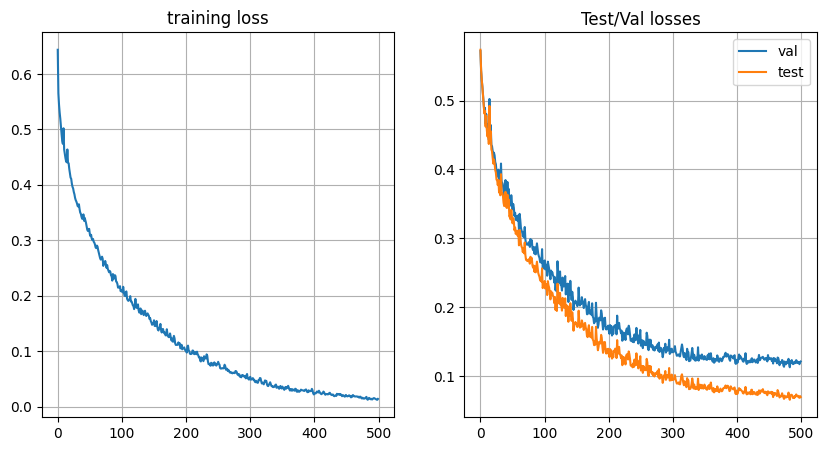
100%|██████████| 500/500 [13:22<00:00, 1.61s/it]
Evaluation
test_node_vals, test_pred = test_data[0][1], model(test_data[0][0]) # test data contains only 1 graph.
from sklearn.metrics import roc_auc_score, f1_score, accuracy_score
roc_auc_scores = [roc_auc_score(test_node_vals[:,i], test_pred[:,i]) for i in range(test_node_vals.shape[1])]
f1_scores = [f1_score(test_node_vals[:,i], test_pred[:,i]>.5) for i in range(test_node_vals.shape[1])]
accuracy_scores = [accuracy_score(test_node_vals[:,i], test_pred[:,i]>.5) for i in range(test_node_vals.shape[1])]
import pandas as pd
pd.set_option('display.max_rows',None)
test_set_metrics = pd.DataFrame([roc_auc_scores, f1_scores, accuracy_scores]).T
test_set_metrics.columns = ['roc_auc_scores', 'f1_scores', 'accuracy_scores']
test_set_metrics.mean()
roc_auc_scores     0.996229
f1_scores          0.977510
accuracy_scores    0.988191
dtype: float64
Comparison with other models
Metric |
GAT |
this model |
|---|---|---|
F1 |
0.973 |
0.978 |
The model performance in F1 score is comparable with the GAT reported in the Graph Attention Networks paper.
It’s possible that with further hyper-parameter tuning or using some self-supervision tricks (e.g., pre-training the newtork on constrastive tasks or as an autoencoder) can bring the performance to state of the art.